DIVA Station, Slovenian Cinematheque: World Day for Audiovisual Heritage
Screening of experimental films from the Eye Filmmuseum from Amsterdam
Tuesday, 27 October 2026, 6 pm and 8 pm
Slovenian Cinematheque, Miklošičeva 28, Ljubljana
Admission according to the Slovenian Cinematheque price list
In 2005, UNESCO declared 27th October as World Audiovisual Heritage Day, which draws attention to the importance of preserving archival audio and audiovisual recordings, such as films, audio and video recordings, and radio and television programs. This heritage also includes the rich artistic production that is kept in Slovenia by DIVA Station (SCCA-Ljubljana) and related archives in other countries.
Every year we mark this day with an event as part of the Archiving Practices programme and we invite international archives, curators and artists as guests. Traditionally we organize the event in cooperation with the Slovenian Cinematheque. This year, we have invited the Eye Filmmuseum from Amsterdam. To mark World Audiovisual Heritage Day, Simona Monizza—a film curator at the Eye Filmmuseum and a specialist in experimental film, restoration, conservation, and dance film—has put together two programmes of Dutch experimental films, which she will introduce before the screenings. The first programme of silent films, The Legacy of Filmlige, showcases an avant-garde group founded in the 1920s that elevated film to an art form. The screening will be accompanied live on the piano by Andrej Goričar. The second program features films by Barbara Meter, a master of independent, expanded cinema and works using found footage.
The Eye Filmmuseum was founded in 1946 and, as the only national museum of film heritage and film culture in the Netherlands, preserves the country’s cinematic heritage with an internationally recognized collection of more than 60,000 films. The collection offers an exceptional overview of film history, from the earliest moving images to classics, blockbusters, and cult films. The ever-growing collection also includes hundreds of thousands of photographs, posters, sheet music, (pre-)cinematographic devices, filmmakers’ archives, and an extensive library. It employs 185 staff members. Thanks to its expertise in film restoration, research, and education, Eye is an internationally recognized institution that also closely follows the latest developments in the world of film by organizing new acquisitions, programs, and discussions. Since 2000, the Eye has been housed in Amsterdam’s IJ Harbor in an iconic building designed by the Austrian architectural firm Delugan-Meissl.
Tuesday, 27 October 2027, 6 pm
PROGRAMME 1
The Legacy of Filmliga
Curator: Simona Monizza
Live musical accompaniment: Andrej Goričar (piano)
In 1927 the foundation of the Filmliga set out the publication of a manifesto by the collective’s leaders Menno ter Braak, L. J. Jordaan and Henri Scholte. Their objective to promote film as art by devoting particular attention to the editing, rhythm and composition of films ranged from Joris Ivens Soviet-inspired documentaries as well as J.C. Mol‘s abstract aesthetics in his science films Uit het rijk der kristallen. The pivotal role of the Filmliga, can be seen as the birthing ground for the vibrant generations to come, who brought the genre of documentaries to a higher level with their own artistic signature. A focus on the groundwork at the beginning of the programme should familiarise us with classic works while transcending the Filmliga’s mission to engage in and further develop the aesthetic discourse. The second part of the programme focuses on the young generation of filmmakers circling around the Joris Ivens studio and its aftermath. These films are clearly influenced by the international avant-garde and they mark the transition to the early sound developments in Dutch cinema.
– Marius Hrdy
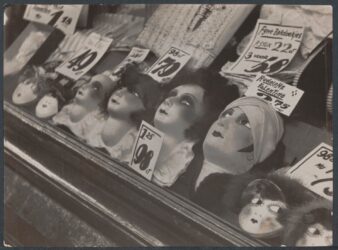
Netherlands, 1929, 35 mm (18fps), 1.33 colour, 11′, silent
German-Hungarian photographer, cameraman and director Andor van Barsy offers a vivid example of a city symphony, featuring a Punch-and-Judy opening and observation of the city-dwelling buzz.
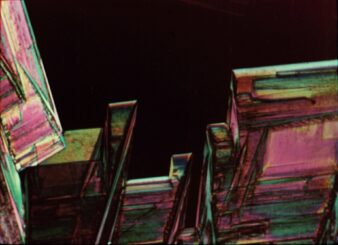
Netherlands, 1927, 35 mm (18fps), 1.33, colour, 9′, silent
Uit het rijk der kristallen is one of the most successful and fascinating scientific films made by Mol. The crystallization processes of various chemicals which are visible only through the microscope are shown using time-lapse acceleration at times. Mol worked several years on this film, producing different versions. Jan Cornelis Mol specialized in shooting footage using the time-lapse technique: at intervals of fifteen minutes or more, he filmed budding plants or flowers so that the flowers seemed to bloom within a few seconds. Mol also experimented with sound and colour systems and was one of the first to introduce optical sound on the amateur film format 16mm.
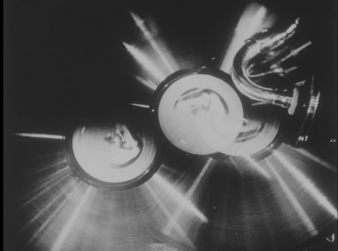
France, 1928, 35 mm, 1.33, bw, 5′, silent
The film is conceived of as a “visual impression in listening to Frédéric Chopin’s Preludes n. 5 and 6”. Its title and its opening shot of lightplay on a spinning record not only announce the film’s dominant cyclical motif, but also evoke one of the filmmaker’s major sources of inspiration in Loïe Fuller’s serpentine dances.
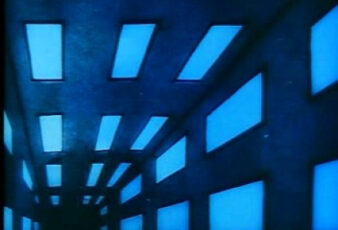
Netherlands, 1933, 35 mm (18fps), 1.33, colour, 5′, silent
‘This film only wants to be harmony; it is not a depiction of a certain subject.’ The film shows abstract and figurative drawings that move and alternate. Balls, circles, lines, but also drawings of women, men and flats move across the screen.
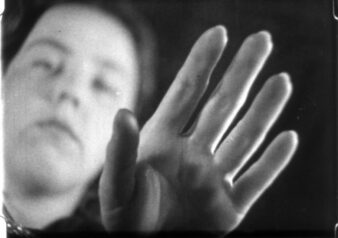
Netherlands, 1934, DCP (shot on 35 mm), 1.37, bw, 6’32”, silent
Experimental film in the form of a sonata, with the parts allegro, adagio and presto. The first part shows, apart from animated dominoes, musical instruments: the keyboard of a piano and a clarinet. It also has images of the drum of a musical box and a gramophone. The adagio is mainly a play of light and dark. The light of the sun, burning candles and cigarettes alternate with images of a hand, trees and a glass of wine.
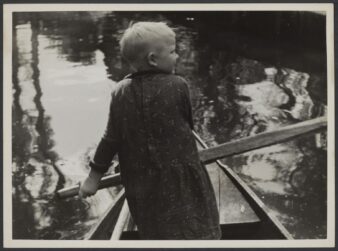
Netherlands, 1935, 35 mm (24fps), 1.37, bw, 11′, no dialogue
A poetic film about Giethoorn (vas na Nizozemskem, v podnaslovu filma poise nizozemske Benetke), with rhythmic images of the village in Overijssel and everyday life.
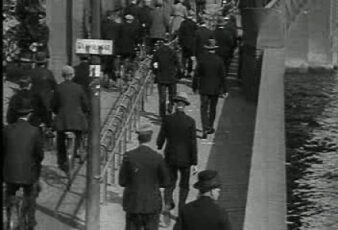
Netherlands, 1937, 35 mm (24fps), 1.37, bw, 14′, no dialogue
Impressions of the various activities on and around the Maas Bridge in Rotterdam.
Tuesday, 27 October 2027, 8 pm
PROGRAMME 1
Found Sounds: A Retrospective of Barbara Meter Avant-Garde
Curator: Mónica Savirón
In the early 1970s, in need of a critical response to the commercialization of film production and programming, Barbara Meter (Netherlands, b. 1939) co-founded the Electric Cinema. Run by members of the Amsterdamse Film Coop, and STOFF (the Studio for the Development of Film and Film Manifestations), the theater became the epicenter of Dutch independent and avant-garde filmmaking. At the Electric Cinema, Meter curated international avant-garde and expanded cinema programmes. After that, she co-created POLKIN (Political Kinema) and made documentaries as part of activist and feminist movements.
In her avant-garde films, she pushes the cinematic medium forward with her unique way of repurposing documents and audio recordings, utilizing an innovative, masterful application of optical printing techniques. Meter manipulates the images and reworks found sounds to find and create a personal expressive mode. Her essay “Looked for and Found: On Archival and Found Footage Film” was written in 1995 for the London School of Printing, and continues to be of radical importance. After many years of work, the EYE Filmmuseum in Amsterdam, working closely with the artist, has preserved Meter’s films in all their delicacy and complexity.
– Mónica Savirón
The programme was cureted by Mónica Savirón in close colaboration with the artist, Simona Monizza and Edith van der Heijde (both Eye Filmmuseum). It has been shown internationally in New York, A Coruña (Spain), Paris, Oberhausen and Uppsala.
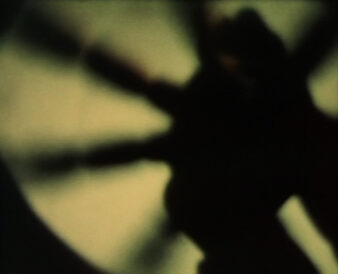
Netherlands, 2004, 35 mm (shot on 8 mm), 1.37, colour, 12′, no dialogue
With images of knitting wheels and vinyl records evoking the labyrinths of Greek mythology, Ariadne, shot on Super-8mm film, reworked and blown up to 16mm with the optical printer, and enlarged to 35mm, is an homage to the quality of cinema as both weaving craft and relentless labour of love.
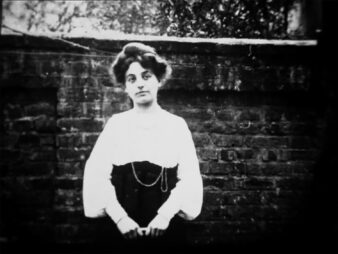
Netherlands, 2000, 16 mm, 1.37, bw, 22′, no dialogue
Meter works with still photographs of Weimar-era Germany that were left to her by her parents, who fled the country in 1934.
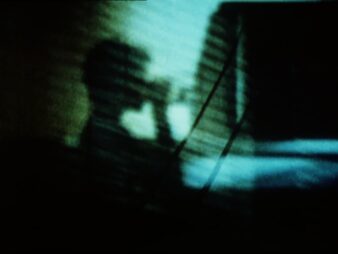
Netherlands, 2000, 16 mm (shot on S8 mm), 1.37, colour, 3′, silent
In this silent, contemplative, reflective work that takes place in a single room, Meter treats her own footage as if it were found, re-shooting and manipulating it as if it had been given to her, trying to figure out what it is and what lays behind it.
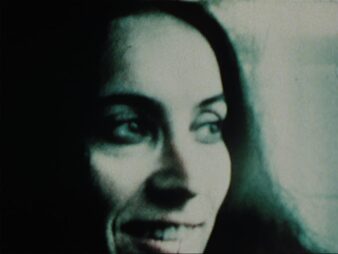
Netherlands, 1970, 16 mm, 1.37, colour, 3′, no dialogue
This is a shot/reverse-shot film that creates a conversation without words between a woman, Barbara Meter, and a man, experimental filmmaker Jos Schoffelen. The film proposes a dialogue deafened by a chord from a Mahler symphony.
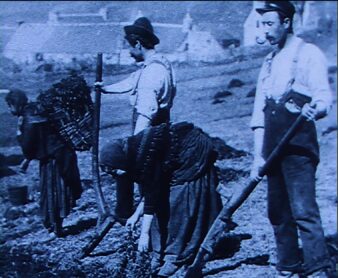
Netherlands, 2005, 16 mm (shot on 8 mm), 1.37, colour, 6′, no dialogue
The word “stretto” is an Italian musical term referring to the final section of a fugue, characterized by interweaving melodies. In the film, Meter, by employing dissociative imagery and disconnected musical tunes, builds on the polyphonic patterns of history and identity. The soundtrack is John Cage’s Music for Prepared Piano 2, a percussion-like piece conceived as a dance accompaniment.
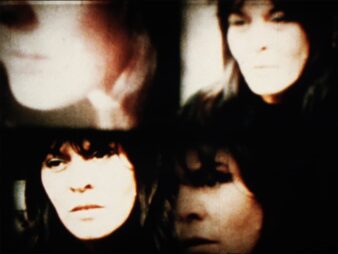
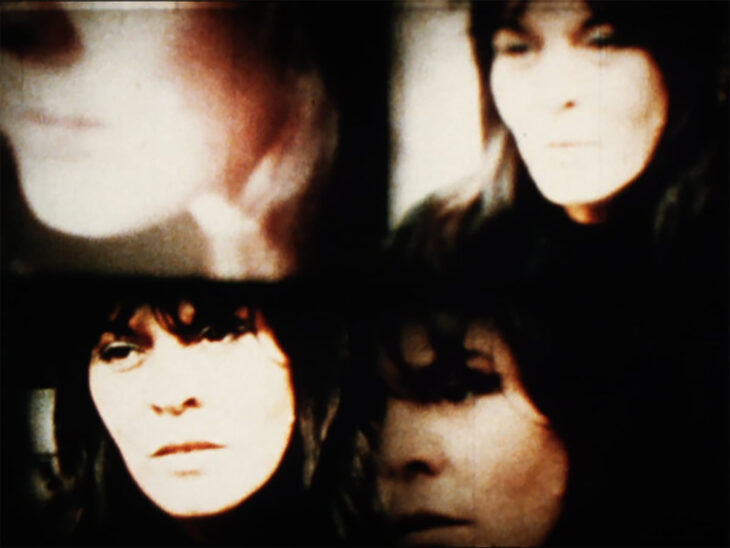
Netherlands, 1972, 16 mm, 1.37, colour, 6′, no dialogue
Alternating one, two, and four screens, Meter features close-ups of artists Sally Potter, Mattijn Seip, Pim van Isveldt, and Mike Dunford from different angles and at fast speed. At the end, a wide, complex portrait may be created by accumulation of layers in the viewer’s mind.
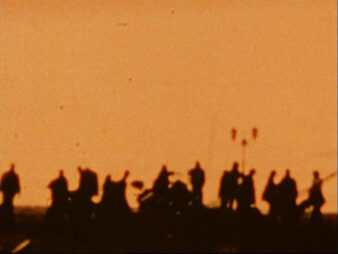
Netherlands/UK, 2008, 16 mm, 1.37, colour, 13′, no dialogue
With sound effects of passing trains, running water, and wind, plus an exquisite imagery manipulation with the optical printer, Meter pays homage to the fragility of celluloid, as well as of our own vulnerable materiality. She treats emulsion as if she were touching skin, with the same attention, permissions, and apprehensions, actions and reactions.
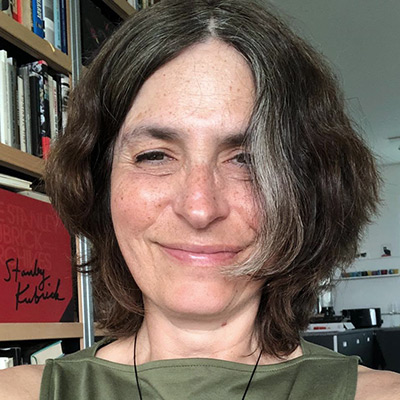 Simona Monizza is a collection curator working at the Eye Filmmuseum, with a specialization in the Dutch experimental and avant-garde film collection, short films and analogue cinema. She graduated in 1998 at the Selznick School of Film Preservation at the George Eastman Museum and has been working as a film restorer and collection curator since then. In her capacity she is responsible for the acquisition, preservation and promotion of the Eye collections with a focus on women’s cinema and has presented several curated programs in the Netherlands and abroad. Her latest curatorial project is the exhibition called Naturocene, which she co-curated. Naturocene is a group exhibition exploring the theme of ecology and the art, at the Project Space On the Inside in Amsterdam. (Photo: personal archive)
Production: SCCA-Ljubljana/DIVA Station
Partners: Slovenian Cinematheque, Eye Filmmuseum
Podpora: City of Ljubljana – Department for Culture