Screening of film/video oeuvre 1998–2025
Screening and lecture
Wednesday, 21 January, 5 pm
Slovenian Cinematheque, Miklošičeva cesta 28, Ljubljana
The screening will be followed by a lecture by Dr. Andrej Šprah as part of the Kino-katedra programme for educators and a presentation of the retrospective catalogue Območje prehoda (Zone of Transition), for which he wrote an extensive essay on the work of Anja Medved and Nadja Velušček.
The lecture and presentation will be held in Slovenian language.
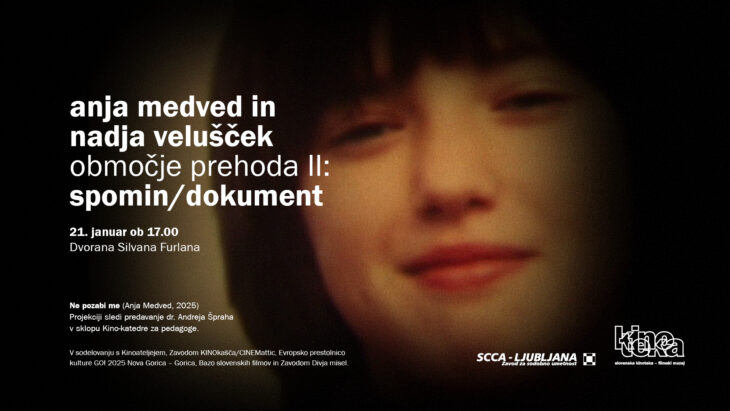
Forget Me Not (Ne pozabi me) – the first feature film by the duo Velušček-Medved – was created as part of the Memory Rescue and Archive Brigade project, which is part of the official film program of the European Capital of Culture GO! 2025. The film features residents of the Goriška region who share their experiences of World War II: they experienced it as children of members of opposing sides, and the authors emphasize that all stories must be heard, but above all, space must be given to memories that have not yet been told.
As Andrej Šprah writes in the retrospective catalog, there are two key levels in the documentary. On the one hand, it is about the use of past materials for different ways of presenting reality. On the other hand, it concerns the relationship with the materiality of the artifacts used, which can have evidential, narrative, and even poetic functions. This also involves, as he says, the affective meaning of objects, since the authors are also emotionally connected to them. He sees their creative gesture as liberating existing images from the yoke of “previous meanings and hegemonic tendencies to attribute reality,” and their project as “creating conditions in which memories could be freed from imposed or prescribed truths.” These are “utopian possibilities of liberation from the burden of meaning through forms of re-recognition, recontextualisation and poeticisation”.
These thoughts are also condensed in the film’s conclusion, which summarizes the poetic style of the Velušček-Medved duo: the camera slowly rises alongside an old tree growing in front of a block of flats, revealing a magnificent panoramic view of the Goriška region, accompanied by Anja Medved’s reflection: “The acacia tree survived the First World War, the Second World War, the breakup of Yugoslavia—it remains rooted in this space, drawing life from the same soil, the same water, the same air… It draws it from space, but not from the space that can be occupied, but from the vastness that cannot be limited and that always finds its way home.” The effort of their films is precisely to open up this expanse beyond the historical and ideological appropriations of the moment and the petrified historical Truths, and to open the way to the polyphony of living experiences.
Robert Kuret
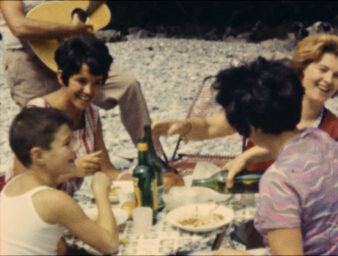
Directed by: Anja Medved, screenplay: Anja Medved, Nadja Velušček, production: KINOkašča / CINEMattic, Slovenia, 2025, DCP, colour, 104′
This documentary essay searches for unspoken family memories of World War II. While sorting through boxes of photographs and film reels, a landscape of memories gradually emerges from the border region between Slovenia and Italy, which was divided by war and political violence in the last century. The childhood memories of the oldest residents also reveal a different view of this area, one that is much more common than what we learned about it in history textbooks. The film weaves together the memories of locals of different affiliations and, with film and photographic documents, builds a familiar narrative of life during the war at a time of renewed calls for armament.
Lecture as part of the Kino-katedra programme for educators
Andrej Šprah
The (Im)Transparency of Reality: The Boundless Cinematic Creativity of Anja Medved and Nadja Velušček
The lecture is based on the essay of the same name in the catalogue of the retrospective of Anja Medved and Nadja Velušček, entitled Zone of Transition. It focuses on some of the fundamental thematic and aesthetic highlights of their extensive documentary oeuvre, with special attention to the film Forget Me Not (Ne pozabi me, 2025), which it considers the undisputed magnum opus of the authors’ creative work to date. The lecture considers it as a work that, in its own way, summarizes, (re)articulates, combines, and builds on the themes, approaches, emphases, and meanings of their previous films, which represent invaluable building blocks of the cultural memory of the space and expanse from which they originate and in which they are situated. At the same time, he argues that, in a formal sense, we are also faced with the most complex undertaking of their creative engagement, marked by a judicious convergence of key previous film forms—essayistic, compilation, landscape, ecological, memorial, testimonial, traumatic, subjective, and (micro)historical documentary.
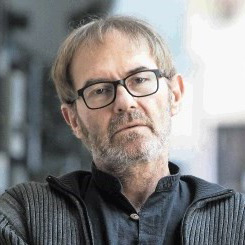 Andrej Šprah jis an assistant professor of film and television studies at the Academy of Theatre, Radio, Film and Television at the University of Ljubljana and a collaborator in the educational programs of the Slovenian Cinematheque. His research focuses on engaged documentary filmmaking, the relationship between fictional and documentary representations of reality, and the cinematography of the former Yugoslavia. His most important publications include the monographs Documentary Film and Power (1998), Liberating the Gaze (2005), The Site of Resistance (2010), Return of Reality (2011), The Uncompromising Vision (2013), and the anthology chapters “Musical Variations in Karpo Godina’s Alternative Cinema” in Popular Music and the Moving Image in Eastern Europe (2019), “Contemporary Newsreel and New Everybody Figures as Mediators in Late Democracies” in: Popularisation and Populism in the Visual Arts Attraction Images (2020) and “Newsreel Front: A Revived Vision of Third Cinema in Slovenia” in: Third Cinema, World Cinema and Marxism (2020). Between 1997 and 2005, he was a member of the editorial board of Ekran magazine, and since 2008, he has been a member of the editorial board of KINO! magazine.(Photo: Matjaž Rušt)
Anja Medved and Nadja Velušček: Zone Of Transition
Screening of film/video oeuvre 1998–2025
Screening and lecture
17 December / 21 January / 18 February / 24 March / 21 April / 8 May / 10 June
Production: SCCA-Ljubljana and Slovenian Cinematheque
Curators: Vesna Bukovec, Robert Kuret
Anja Medved (1969) and Nadja Velušček (1948) are mother and daughter who have been working together as authors since the late 1990s. Their joint work focuses on exploring the Slovenian-Italian border region. In doing so, the authors subtly delineate the personal and the public: they draw on intimate narratives and vivid testimonies from individuals’ personal archives, connecting them to the history of grand narratives, thus carefully revealing the polyphony of historical Truth. Since most of the films are medium-length documentaries, we have paired them to provide an overview of their creative oeuvre. Moreover, because the films are so open and thematically polyphonic due to their fragmentary, essayistic nature, practically every combination activates certain connections. Therefore, we wanted to design the program so that the juxtaposed films would articulate the border and the borderline anew each time. Seven program sections with the titles Gorica / Nova Gorica, Memory / Document, Environment / Territory, Water Level / Watercourse, Peace / War, Violence / Compassion, Departures / Arrivals will be screened from December to June at the Slovenian Cinematheque and in May at the Vodnikova domačija. Part of the program will also be available on the Slovenian Film Database during the retrospective.
Coproduction: SCCA-Ljubljana/DIVA Station and Slovenian Cinematheque
Partner: Slovenian Film Database (BSF), Zavod Kinoatelje (SLO), Kinoatelje (ITA), Zavod KINOkašča / CINEMattic, Zavod Divja misel (Vodnikova domačija), GO! 2025 Nova Gorica Gorizia
Supported by: Ministry of Culture of the Republic of Slovenia, City of Ljubljana – Department of Culture
Thanks: RTV Slovenija, Slovenski program RAI, Andrej Šprah, Vlado Škafar, Tina Popovič