Screening of film/video oeuvre 1998–2025
Screening and talk
Tuesday, 21 April 2026, 8 pm
Slovenian Cinematheque, Miklošičeva cesta 28, Ljubljana
Online screening of the accompanying programme at the Slovenian Film Database
(21 – 28 April 2026)
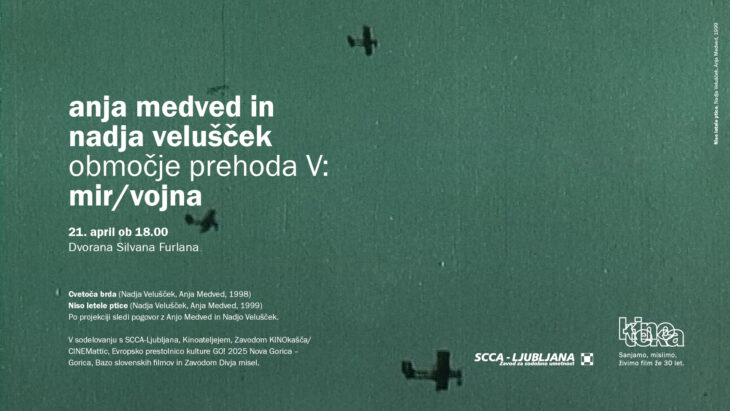
This programme dates back to the very beginnings of Anja Medved and Nadja Velušček’s creative careers, as these are their first two works. Initially, they wanted to make a film about the border. However, Filibert Benedetič, director of the Slovenian program at RAI in Trieste, suggested—along with the title—that they make a film about the Goriška Brda region instead. While filming, they met people who remembered the Isonzo Front, and thus their first medium-length documentary, The Birds Did Not Fly (Niso letele ptice, 1999), was created. Anja Medved emphasizes that the film never once mentions the classic elements of the Isonzo Front’s history (regiments, divisions, battles), but rather consists of fragments of memories from those who experienced World War I as children—memories we will not find in history textbooks. Thus, right from the start of their work, they adopted an approach to history that looks from the bottom up; a method popularized by American historian Howard Zinn in his 1980 book A People’s History of the United States and encapsulated in Anja Medved’s thought from the film Forget Me Not (Ne pozabi me, 2025): “Everyday life does not stop during war.” At the same time, The Birds Did Not Fly marked the beginning of the parallel creation of an archive.
Blooming Brda (Cvetoča Brda, 1998), the first film by this directorial duo, features several distinctive elements, notably Nadja Velušček’s opening fairy-tale-like narration, which does not reappear in this form in their later films. In this way, the portrait of Brda—which, like their other films, spans from the war-torn past to contemporary economic activities and the appreciation of the landscape—subtly acquires magical qualities. In the film The Birds Did Not Fly, too, we can observe certain narrative techniques that the filmmakers abandoned in their later works: a significant portion consists of diary entries, personal notes, and newspaper articles read by a voice-over. Newspaper articles, in particular, serve as external or public reference points for key historical events—such as the outbreak of war—that frame the individual narrative voices. In their subsequent films, the filmmakers abandon this device of narrative authority, leaving the interpretation of the specific historical context or moment to the montage of narrative voices and the viewer’s further exploration.
Robert Kuret
The screening will be followed by a discussion with Anja Medved and Nadja Velušček.
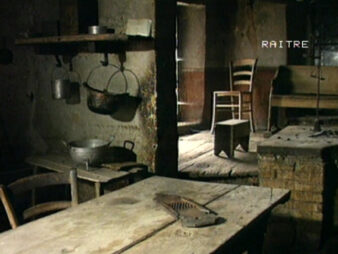
Director, Screenwriter: Nadja Velušček, Anja Medved, production: RAI regional headquarters for Friuli-Venezia Giulia – Slovenian program , Kinoatelje (ITA), Italy, 1998, video miniDV, colour, 30′
A day in the Goriška Brda region, where the sun rises in one country and sets in another. Scenes from life on both sides of the border that are fading away, and the people of this land steeped in history, who find themselves at the threshold of a new millennium.
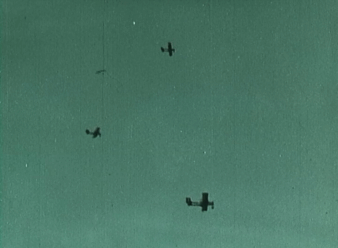
Director, Screenwriter: Anja Medved, Nadja Velušček production: RAI regional headquarters for Friuli-Venezia Giulia – Slovenian program , Kinoatelje (ITA), Italy 1999, video miniDV, barvni, 42′
Childhood memories of the last surviving witnesses of World War I. The war caused some of the worst devastation in the towns along the Soča River. The sky, which until then had belonged to birds and gods, was now filled with people. “Those are not birds,” Juština’s mother shouted to the children when planes first flew over Brda. They were forced to flee. When they returned, they started from scratch. Over time, nature restored this world, but the sense of the sacred was lost forever.
Zone of Transition V: Peace / War
21 – 28 April
» View at Slovenian Film Database (BSF)
In this accompanying program for the retrospective of Anja Medved and Nadja Velušček’s film oeuvre, we will have the opportunity to view films that explore various aspects of creativity and creators: Salt and Sand (2003), a portrait of Trieste-based poet, writer, essayist, and translator Marko Kravos, who, on the occasion of his milestone birthday and the publication of a poetry collection, demonstrates his characteristic vitality. Painting with Soil (2006) is a documentary reportage about the art colony in Medana, which highlights not only creativity, as well as the community that forms around it (and it seems that communities emerging from artistic or other forms of creation are also one of the key subthemes in both the collaborative work of Anja Medved and Nadja Velušček and in Anja Medved’s independent projects). With her latest film, Renato’s Plan (2014), the creative gesture transcends the realm of art, presenting a portrait of Renato Borghi as he builds a small hydroelectric power plant with his own hands.
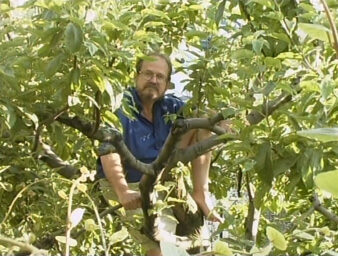
Anja Medved, Nadja Velušček, Italy, 2003, 18′
On the birthday of the Trieste poet Marko Kravos and the publication of his poetry collection.
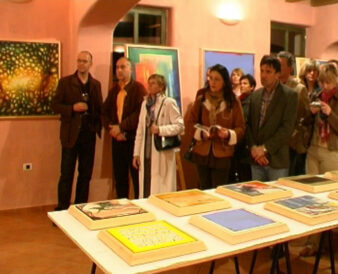
Anja Medved, Slovenia, 2006, 23′
A documentary report on the MMMArt art colony in Brda.
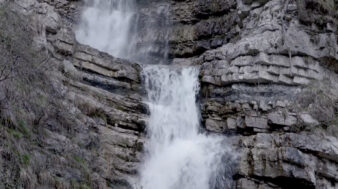
Anja Medved, Italy, 2014, 17′
For fifteen years, Renato “Collovet” Borghi has been making his dreams come true: he tames a torrent, builds cargo cableways and a small hydroelectric plant—all with his own two hands. He is a man who moves mountains, creating works of epic poetry in the process.
This short documentary was created as part of the public space installation “Eternal Construction Site” within the cross-border year-long project “Distances 2013/14,” organized by UNIKUM Klagenfurt.
Anja Medved and Nadja Velušček: Zone Of Transition
Screening of film/video oeuvre 1998–2025
Screening and lecture
17 December / 21 January / 18 February / 24 March / 21 April / 8 May / 10 June
Production: SCCA-Ljubljana and Slovenian Cinematheque
Curators: Vesna Bukovec, Robert Kuret
Anja Medved (1969) and Nadja Velušček (1948) are mother and daughter who have been working together as authors since the late 1990s. Their joint work focuses on exploring the Slovenian-Italian border region. In doing so, the authors subtly delineate the personal and the public: they draw on intimate narratives and vivid testimonies from individuals’ personal archives, connecting them to the history of grand narratives, thus carefully revealing the polyphony of historical Truth. Since most of the films are medium-length documentaries, we have paired them to provide an overview of their creative oeuvre. Moreover, because the films are so open and thematically polyphonic due to their fragmentary, essayistic nature, practically every combination activates certain connections. Therefore, we wanted to design the program so that the juxtaposed films would articulate the border and the borderline anew each time. Seven program sections with the titles Gorica / Nova Gorica, Memory / Document, Environment / Territory, Water Level / Watercourse, Peace / War, Violence / Compassion, Departures / Arrivals will be screened from December to June at the Slovenian Cinematheque and in May at the Vodnikova domačija. Part of the program will also be available on the Slovenian Film Database during the retrospective.
Coproduction: SCCA-Ljubljana/DIVA Station and Slovenian Cinematheque
Partner: Slovenian Film Database (BSF), Zavod Kinoatelje (SLO), Kinoatelje (ITA), Zavod KINOkašča / CINEMattic, Zavod Divja misel (Vodnikova domačija), GO! 2025 Nova Gorica Gorizia
Supported by: Ministry of Culture of the Republic of Slovenia, City of Ljubljana – Department of Culture
Thanks: RTV Slovenija, Slovenski program RAI, Andrej Šprah, Vlado Škafar, Tina Popovič